


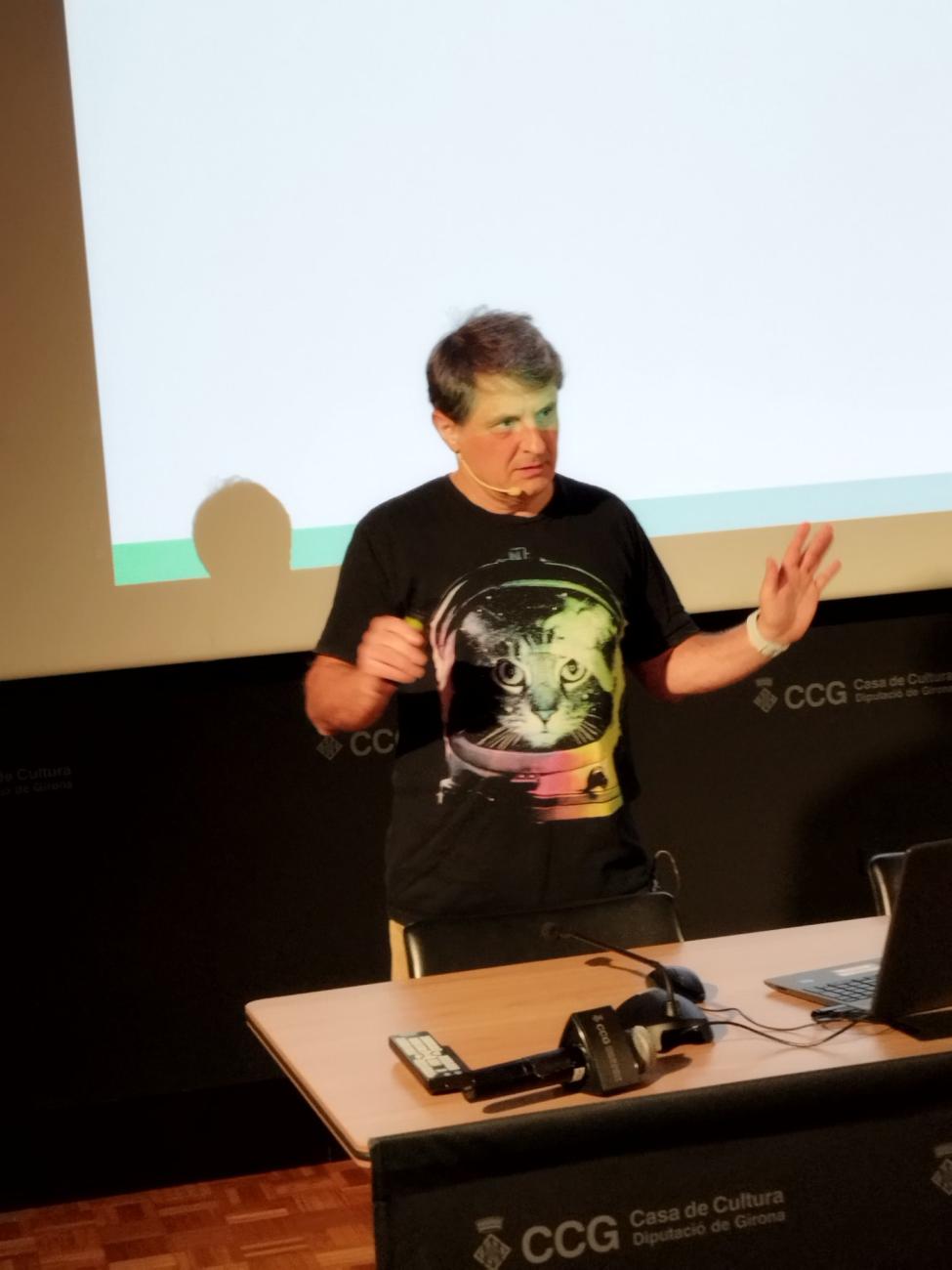
Seminar by Adan Cabello (U. de Sevilla)
Quantum contextuality reveals the failure of a seemingly reasonable intuition: that a
measurement reveals a preexisting property of the measured system. This is the
physical content of the theorems of Kochen and Specker (1960–1967) and Bell
(1963) stating the impossibility of reproducing quantum theory with a class of hidden-
variable theories, later called “noncontextual hidden-variable theories”. However, for
years, it was thought that, in contrast to Bell’s theorem, the KS-Bell theorem could
neither be formulated without “the formal structure of quantum mechanics” nor
described “in terms of a collection of black-box gedanken experiments”. This started
to change in 1998 and definitively changed in 2008. Since then, quantum
contextuality has evolved into a rich field in its own right. Nowadays contextuality is
arguably the best conceptual tool guiding our understanding of quantum theory.
Moreover, contextuality has been identi ed as a necessary resource for quantum
computational advantage in some models of fault-tolerant quantum computation.
In this seminar, we discuss how to define contextuality in a theory-independent
manner, such that it provides a natural generalization of Bell's nonlocality to
compatibility scenarios that cannot be embedded into Bell scenarios. We also
present basic examples of quantum contextuality illustrating two striking features—
namely, that contextuality can be exhibited by individual qutrits and can be state-
independent. Finally, we list several applications of quantum contextuality and
explain why it offers crucial insight into nonlocality and, ultimately, into the
foundations of quantum theory.