


Quantum simulation and Thermodynamics of complex systems
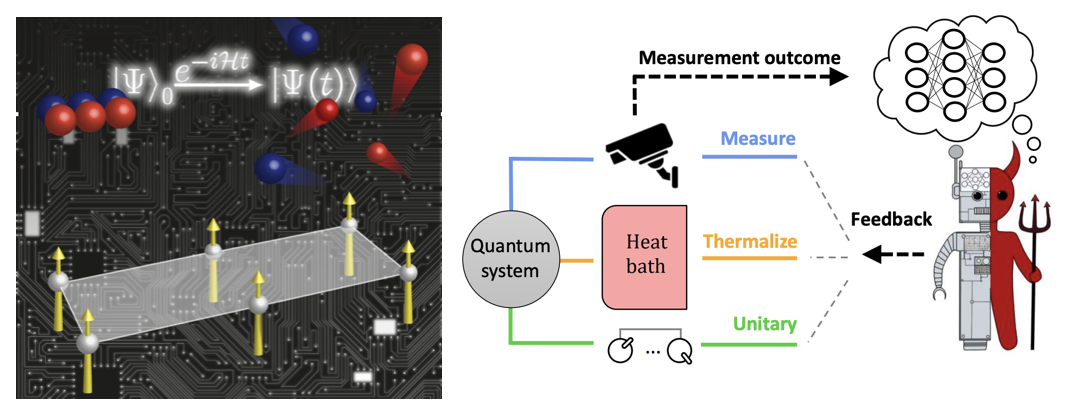
Quantum devices—such as digital quantum computers and quantum thermal machines—are redefining the boundaries of technology, promising capabilities that are out of reach for their classical counterparts.
On the one hand, the simulation of complex models can be achieved by mapping the original problem onto quantum hardware. In the long run, this approach may enable us to compute the dynamics of systems that are currently intractable for classical supercomputers, such as non-perturbative regimes of quantum chromodynamics or strongly interacting many-body systems, where interactions set the dominant energy scales. This research direction, known as Quantum Simulations, is widely regarded as one of the most promising routes to the so-called quantum advantage, i.e., a demonstrated scenario in which a quantum machine can efficiently simulate something that cannot be simulated efficiently by classical means.
In parallel, quantum systems can exhibit thermodynamic behaviours that may, in principle, surpass the limitations of classical thermal machines, opening a distinct notion of quantum advantage. Turning this promise into reality requires learning how to control and accurately model real quantum dynamics: perfect isolation does not exist, and interactions with the environment tend to degrade coherence and quantum correlations irreversibly. At the nanoscale, fluctuations of measurable quantities become as important as their averages, directly impacting performance and reliability. Achieving precision and suppressing fluctuations is not “free”: every simulation, measurement, and control protocol carries a Thermodynamic Cost in terms of energy, dissipation, and irreversibility. This is the domain of Quantum Thermodynamics, whose goal is to understand—and ultimately minimise—such costs, a crucial step toward the next generation of efficient quantum technologies.
Main research lines
- Quantum simulation of the dynamics of complex models: protocols to map the dynamics of non-perturbative models into quantum algorithms executable on digital quantum computers, both in the near-term (NISQ) era and, prospectively, in the fault-tolerant regime.
- Preparation and evolution of open quantum states: protocols to generate, stabilise, and manipulate quantum states in the presence of noise, dissipation, and measurement, with a focus on efficiency, implementability, and robustness.
- Thermodynamic geometry and the quantum Maxwell demon (stochastic level): fundamental limits and optimal protocols linking information, measurement, and feedback to dissipation and precision; trajectory-level analysis of work, heat, and fluctuations.
- Quantum thermometry: strategies and ultimate limits for estimating temperature and environmental parameters with quantum probes, quantifying trade-offs between precision, time, and energetic resources.
- Collision models and quantum batteries: microscopic, modular descriptions of open quantum systems (both Markovian and non-Markovian dynamics), applied also to energy storage and extraction in quantum batteries, balancing power, efficiency, and fluctuations.
Group leaders: Dario Gerace, Giacomo Guarnieri, Chiara Macchiavello
Group members: Luca Razzoli, Davide Cugini, Gaia Candreva, Francesco Ghisoni, Davide Rinaldi, Emanuele Tumbiolo